|
Monday, June 2nd, 2008
officialgaiman
|
10:46p
Big catch up post
http://journal.neilgaiman.com/2008/06/big-catch-up-post.html Home from the road. Today was quiet, all walks and bees. (While I was away Lorraine and Sharon had a Bee Adventure. Today I checked on the bees and they were all happy.)
Book Expo America was terrific but amazingly long -- my Friday began around 6.00am (getting ready for the author breakfast) and finished around 11:15pm (shortly before the end of the Audie awards, at which I was a presenter), with, on the way, a two and a half hour signing and an hour signing and a Graveyard Book meeting about how we're going to do the US tour in the autumn (the plan is to do a reading tour rather than a signing tour, closer than the Cody's event I did for Fragile Things which you can watch at Fora TV -- http://fora.tv/2006/10/02/Neil_Gaiman).
The first signing was a bit of a mess -- they'd scheduled it for the second the breakfast was meant to have ended, but it ran late and I was the last speaker and so didn't even get up to talk until after that, and they'd given out 350 tickets for an hour's signing (10.2 seconds per person ) with no real thought as to how they'd get those people through the line in that time. Which was why it was a two and a half hour signing instead of being an hour signing. The second signing, of The Dangerous Alphabet with Gris Grimly, was a lot less hectic (and we met Berkely Breathed, signing at a nearby table, and I got to be a fanboy).
I loved the breakfast -- Jon and Eoin and Judy and Sherman are the best and funniest people, and my only regret was that we didn't get any time together afterwards.

The breakfast. Left to Right: Me, Jon, Eoin, Sherman, Judy. Jon Sczieska is mostly hidden by a photographer. Also, it's pronounced Sheska.
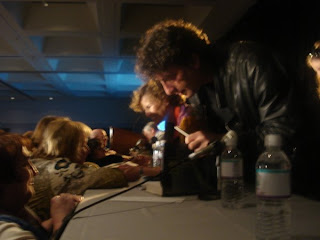 At the end of the breakfast all 1200 people descended upon us (well, it felt like it). I signed one book before I was swept away to do my own signing... At the end of the breakfast all 1200 people descended upon us (well, it felt like it). I signed one book before I was swept away to do my own signing...
 Judy Blume and me. She was so funny and so nice and so very, very sharp. Judy Blume and me. She was so funny and so nice and so very, very sharp.

Gris Grimly and I signed Dangerous Alphabets for people. He asked if we could trade the portraits we did of each other in the back of the book, and I had to admit that I suspected that I'd left the one I did of him in Dave McKean's studio, as I drew it there, and Dave scanned it for me and we sent it off. So I shall investigate.
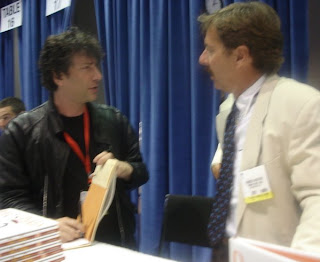
Saying hello to (and exchanging Douglas Adams reminiscences with) Berkeley Breathed. I signed a book for him. He signed a book for me. I love my life
[Coincidentally, as I typed that, the phone rang. It was Berkeley Breathed trying to get an email address for me that worked, as he'd been given my old bigfoot.com address, which I've stopped using as it worked, well, barely. I just got to tell him how the person buying Bloom County collections from Forbidden Planet in 1985, that was me!]
Saturday was less stressful but just as crammed. Entertainment Weekly had asked for a photo of me for an upcoming special issue, and they sent a stylist and some clothes along. I went into this very warily: this is the third EW shoot since the blog started. The first was at the House on the Rock in 2001, and was a bit of an endurance test: I stood beside the World's Largest Carousel for several hours unable to communicate with the photographer over the noise of the music; the next was in 2003, and was again something of an endurance test: I almost bit through my tongue and the resulting image was a very good photo of somebody who didn't look like me at all secretly sucking on an ice cube to stop the bleeding.
This time it was... pleasant. Christopher McLallen was the photographer, and he was great. No clenching of teeth or whirring fans, no eternal carousel music and huge automatic drums making it too loud to talk or think. They put me in a black jacket and a black on black stripy tee shirt, and then in a pin-stripe suit that felt so Gomez Addams I found myself humming the Vic Mizzy TV theme (not the song, but the bit of incidental music where people walk up the path to the house) while the photos were taken. I don't really ever wear suits, but if I did, I'd wear that one.

The nice lady you can see in this picture (who has had to run out every few minutes to unrumple or uncrease me) is Joey Tierney, the stylist. Just behind me, Heather the assistant is moving a light.
From there to a PEN event, to a CAA event, to a Harper Collins event, and finally to dinner, which I found using my phone and the new magic free version of Google Maps for phones that turns your phone into a GPS system. ... Right. Lots of links and things to post, so I can close some tabs.... Claudia Gonson does a mix tape. Harlan Ellison on Studio 360. A 58 year old lady in Japan was arrested for secretly living in a someone's closet. Thea Gilmore interviewed in the Guardian. (And I sigh, because though it's an article saying that she's one of the finest living singer-songwriters, it's in the women's lifestyle pages, rather than being the lead article in their music and arts pages.) The end of the Endicott Studio. Lisa Snellings Clark makes strange, magical art things out of the honey and bees that I sent her. (And then, being Lisa, she puts the things up on eBay for the Comic Book Legal Defense Fund. Here's Bee, Honey, Drones and a Poppet and here's the Queen bee in repose) A miracle fruit that does strange things to the taste buds. The Library Journal recommends books on fantastic cities and urban magic. Meanwhile the Guardian just recommends books that will take you to magical places. Julian Gough stole Will Self's pig. And finally, Hi Neil, I'm sure others have pointed this out already, but ... you should have said "the perils of therianthrophy". "Lycanthropy" refers specifically to werewolves; "therianthropy" refers to all breeds of animal shapeshifter. After discovering they're still active, I'd be careful about unwittingly insulting them ...Matt I always wonder why people get most pedantic about things they've got wrong. I've done it myself, sometimes here on this very blog. When I was about ten my favourite article in the huge and mouldering Encyclopedia Brittanica we owned (the ninth edition) was the one on Lycanthropy. (Yes, I had a favourite 1890s Britannica article when I was ten. I am now aware this is not entirely usual.) I read it over and over and even wrote what I fancied was a highly original dramatic short story set in a police station in which a woman transformed herself into a cat (or possibly vice versa, time has fuzzed the details). When I was ten I was the kind of child who would have taken enormous pleasure in telling you that, LYCANTHROPY is a term used comprehensively to indicate a belief, firmly rooted
among all savages, and lingering in the form of traditional superstition among
peoples comparatively civilized, that men are in certain circumstances
transformed temporarily or permanently into wolves and other inferior animals.
In the European history of this singular belief, wolf transformations appear as
by far the most prominent and most frequently recurring instances of alleged
metamorphosis, and consequently in most European languages the terms expressive
of the general doctrine have a special reference to the wolf. Examples of this
are found in the Greek lukanthropos, Russian volkodlák, English were-wolf,
German währwolf, French loup-garou. And yet general terms (e.g., Latin,
versipellis; Russian, óboretne; Scandinavian, hamrammr; English, turnskin,
turncoat) are sufficiently numerous to furnish some evidence that the class of
animals into which metamorphosis was possible was not viewed as a restricted
one. It is simply because the old English general terms have been long diverted
from their original signification that the word "lycanthropy" has recently been
adopted in our language in the enlarged sense in which it has been defined
above.
You can read the whole article at http://www.1902encyclopedia.com/L/LYC/lycanthropy.html
You can read the longer and different 1911 Britannica article, which states, Although the term lycanthropy properly speaking refers to metamorphosis into a wolf (see Werwolf), it is in practice used of transformation into any animal at --
http://www.1911encyclopedia.org/Lycanthropy And now I'm going to take the dog for a walk. The next few days will be spent in the KNOW studios in St Paul recording THE GRAVEYARD BOOK audio.
(All photos by the wonderful Cat Mihos.
|
(1 comment | comment on this) Tuesday, June 3rd, 2008
wired_news
|
4:00a
Wired.com Photo Contest: Summer
http://feeds.wired.com/~r/wired/index/~3/303434044/submissions_summer http://www.wired.com/culture/art/news/2008/06/submissions_summer Summer is finally here, and we under-sunned desk turds want to see what fun looks like. Remind us what it is to be young and capable of joy again with a skillfully captured frame.
Use the Reddit widget below to submit your best summer photo and vote for your favorite among the other submissions. The 10 highest-ranked photos will appear in a gallery on the Wired.com home page. We want to see itchy bug bites and rickety bunk beds, sparklers and barbecues. Take us on a manic road trip through fireflies and wine vines, and leave us sipping margaritas on umbrellaed beaches. If it doesn't scream "summer," we don't want to see it.
The photo must be your own, and by submitting it you are giving us permission to use it on Wired.com and in Wired magazine. Please submit images that are relatively large, the ideal size being 800 to 1200 pixels or larger on the longest side. Please include a description of your photo, which may include exposure information, equipment used, etc.
We don't host the photos, so you'll have to upload it somewhere else and submit a link to it. If you're using Flickr, Picasa or another photo-sharing site to host your image, please provide a link to the image directly and not just to the photo page where it's displayed. If your photo doesn't show up, it's because the URL you have entered is incorrect. Check it and make sure it ends with the image file name (XXXXXX.jpg).
Please bookmark this page and check back periodically over the next two weeks to vote on new submissions!
Also, check out the winner's galleries from our previous contests: Holga, Red, Self-Portrait, Night, Macro, Transportation, and Black and White.
Vote on summer photos submitted by other readers.
Show entries that are: hot | new | top-rated. Submit your summer photo.
Submit your summer photo.
(No more than one every 30 minutes. No HTML allowed.)
Back to top


|
(comment on this)
wired_news
|
4:00a
Top 10 Wired Water Photos, Decided by Us
http://feeds.wired.com/~r/wired/index/~3/303434045/gallery_faves_water_photos http://www.wired.com/culture/art/multimedia/2008/06/gallery_faves_water_photos  : : Though Wired.com readers selected 10 excellent photos in our water photo contest, we here at the Photo Department like to fight for the underdog. Here are our 10 favorite submissions that we think deserved more attention.
Our next bi-monthly photo contest is summer. Let us office shmoes live vicariously through your best summer photo. Check out the contest page for more information.
Left:
Amazon Worker
Submitted by Fernando Martinho
Photographer's comment:
"This man works producing charcoal of illegal wood. He drinks the same water he is destroying...."
 : : Water Feet
Submitted by Elliot Carvalho
Photographer's comment:
"A kid takes a dive on Ipanema Beach, Rio de Janeiro"
 : : Floating in Color
Submitted by Kristarella
Photographer's comment:
"On Lake Macquarie, New South Wales, Australia."
 : : Puddle Beamer
Submitted by AmsterS@m
Photographer's comment:
"BMW reflected in a puddle in Amsterdam, shot with my Sony Ericsson S700i mobile-phone cam."
 : : Falling Drops
Submitted by Anonymous
Photographer's comment:
"Drops of water falling from the wall in Hong Kong"
 : : Mnemonic
Submitted by Orion Schmidt
Photographer's comment:
"View of St. Sebastian's Church in Salzburg, Austria. Taken on a Nikon pocket point-and-click."
 : : This Sunset Brought to You By:
Submitted by Petter Duvander
Photographer's comment:
"Take that for showing all those horrible infomercials!"
 : : Red Bridge
Submitted by Paco Alcantara
Photographer's comment:
"A bridge in Wakayama Prefecture, Japan"
 : : Nature's Testament
Submitted by Vilhjalmur Ingi Vilhjalmsson
Photographer's comment:
"Skogarfoss, a 60-meter-high [nearly 200-foot] waterfall in southern Iceland. Legend tells that behind the waterfall is a treasure chest filled with unimaginable riches. The story goes that a man ventured behind the falls and grasped the handle on the chest, only for it to vanish in front of his very eyes."
 : : Cubicle
Submitted by vofi
Photographer's comment:
"Built in 1902, and still smooth."


|
(comment on this)
wired_news
|
4:00a
June 3, 1657: William Harvey Taken Out of Circulation
http://feeds.wired.com/~r/wired/index/~3/303434046/dayintech_0603 http://www.wired.com/science/discoveries/news/2008/06/dayintech_0603 1657: The blood stops circulating in the body of the scientist who definitively established that blood indeed circulates. William Harvey is dead.
Most scientists and physicians in Harvey's time were still blindly following the second-century Greek physician Galen, who proved that arteries contain blood. But he thought that the liver converted food to blood and that the arteries and veins are distinct systems. Galen warned his students not to be content with book knowledge, but 14 centuries of doctors relied instead on Galen's many anatomical treatises and did not themselves perform dissections.
In the century before Harvey, Belgian anatomist Andreas Vesalius published charts of his own dissections. Vesalius' work literally resurrected the practice of dissection of human cadavers: It was still widely forbidden, and for centuries to come often had to be performed in secret on newly dead bodies stolen from cemeteries by "resurrection men."
Cairo physician Ibn al-Nafis had established the "lesser circulation" between heart and lungs in the 11th century. Hieronymus Fabricius, of Italy, published a work on the valves in the veins in 1603, but he mistakenly saw them as imposing a speed limit on the flow of blood from the heart. However, al-Nafis' work was not widely known in Christian Europe, and no one put it together with the true import of Fabricius' research.
Until William Harvey.
Harvey experimented on animals and even on surface veins in the limbs of living humans. In 1628, he published his magnum opus, Anatomical Disquisition on the Motion of the Heart and Blood in Animals -- often called De Motu Cordis for the literal heart of its original Latin title.
It demonstrated conclusively that the heart pumps blood to the rest of the body, and that the veins return the blood to the heart. With the microscope not yet available, Harvey could not see what connects the smallest arteries to the smallest veins, but he postulated the existence of the capillaries.
Harvey also served as a royal physician. How did he get a plum job like that? The man was talented, but he also had the good judgment to marry the daughter of another royal physician.
As doctor to King Charles I, Harvey did a lot of scrambling during the English Civil War, losing most of his scientific papers and ordinary possessions to anti-royalist riots. He fled London to Oxford with the court in 1642, then left the court (and his job) to return to London in 1646. Thus, he was not royal physician when the king was beheaded in a public execution on a London street in 1649. Plenty to learn about the motion of blood there.
Harvey published his second major work, On Generation in Animals, in 1651. In it, he propounded the notion that an animal embryo grows gradually, in parts, and does not exist fully formed in miniature in the ovum, as much current theory then held. Harvey's ideas, as with circulation, were based on direct observation and measurement.
But the founder of modern experimental physiology, cardiology and embryology was again impeded by not being able to observe the microscopic level: the earliest, smallest stages of embryonic growth. Antony van Leeuwenhoek did not make the first practical microscopes until two decades after Harvey's death.
Harvey died at age 79. The cause of death was a stroke, which we now know to be a circulatory disease.
Source: PBS' Red Gold


|
(comment on this)
(comment on this)
(comment on this) Monday, June 2nd, 2008
(1 comment | comment on this)
boingboing_net
|
10:05p
Doug Engelbart's "mother of all demos" video from 1968
http://feeds.feedburner.com/~r/boingboing/iBag/~3/303403335/doug-engelbarts-moth.html
Myst co-creator Robyn Miller writes about computer pioneer Doug Engelbart's "mother of all demos" from 1968.
What I didn't know until recently, is that a stunted version of hypertext had been demonstrated as early as 1968. This was no run-of-the-mill boring-vision-of-the-future demo. This was, simply put, "The Mother of All Demos". Steven Levy first gave it that name and it seems to have stuck: The Mother of All Demos (and oh I really love that name). Douglas Engelbart's whirling vision of the future; it was the first public use of a mouse, as well as examples of cutting, copying, pasting, teleconferencing, video conferencing, email, and... hypertext. It's just too damn much for 1968! From Steven Levy in his book, Insanely Great, The Life and Times of the Macintosh, the Computer That Changed Everything:
"... a calming voice from Mission Control as the truly final frontier whizzed before their eyes. It was the mother of all demos. Engelbart's support staff was as elaborate as one would find at a modern Grateful Dead concert. ..."
Link


|
(comment on this)
leaky_cauldron
|
10:23p
Helen McCrory: Narcissa Malfoy is a "Baddie with a Heart"
http://www.the-leaky-cauldron.org/index.php?articleID=11011 Actress Helen McCrory was a guest on the BBC Radio 4 program "Woman's Hour" during which she spoke of her upcoming role as Narcissa Malfoy in the "Harry Potter and the Half-Blood Prince" film. Appearing on the show to discuss...
|
(comment on this) Tuesday, June 3rd, 2008
wired_news
|
1:00a
Killer Gamer Asks, 'Where Have All the Bodies Gone?'
http://feeds.wired.com/~r/wired/index/~3/303360588/gamesfrontiers_0603 http://www.wired.com/gaming/gamingreviews/commentary/games/2008/06/gamesfrontiers_0603
Something quite interesting happens in the first few minutes of Ninja Gaiden II: The dead people don't vanish.
About five minutes into the game, I finished my first battle, and it was a grisly spectacle of carnage. I'd killed about seven guys, and their corpses lay scattered about. Then I went around the corner to save my progress at the "sacred statue."
When I turned around ... the bodies were still there.
All seven of them. Everything was intact: the fractal flowers of blood on the walls, the body pieces I'd severed from their hosts -- a couple of legs, a stray arm -- scattered like doll parts.
Why was this so weird? Because the bodies weren't gone.
In the originalNinja Gaiden, every time you killed someone, within a few seconds the body would poof away in a cloud of eldritch smoke -- leaving nothing behind, not even a bloodstain. You'd dispatch 20 guys, go around the corner to snare some loot, and when you came back a few seconds later, the fight scene was as clean and sterile as an operating room.
This phenomenon is not limited to the first Ninja Gaiden. Over the years, I've noticed that most of the seriously violent games I love deal with the corpses by simply whisking them away. Take the recent Grand Theft Auto IV: I'd butcher my way through a gunfight, wander off to admire the view out a window, then on the way back to my car discover that the bodies were gone, neatly as if they'd been Raptured. Nothing left behind but their ammo!
On the one hand, this vanishing-body thing is such a blasé convention of gameplay that it's barely worth mentioning. No big deal, right? Often the designers make the bodies disappear for reasons of gameplay, because leaving all the bodies piled up is ludologically impractical: If every monster killed in World of Warcraft hung around forever, Azeroth would be so chest-deep in stinking corpses that you couldn't walk anywhere. The sheer metric tonnage of killing in our favorite games essentially requires that there be some sort of cleanup crew.
But still, I wonder if there isn't a moral effect here, too.
I mean, I've been gaming for 25 years. How many people -- or monsters, or entities, or robots, or whatever -- have I killed? If you add up all those gunfights, laser battles, BFG attacks, crazy Japanese RPG spellcasting deaths, throat-slittings from behind, starcraft pulverized by plasma missiles: Man, it's probably nearing a million or something. That's war criminal territory.
So when you put it that way, this idea -- that the bodies of everyone we kill just sort of wink out of existence -- is so hilariously pregnant with misplaced dread that it's practically Freudian. It's as if our violent games can't quite bear to have us face up to the dimensions of what we're doing. So they just get rid of the evidence.
Now, I'm not saying that games turn us into killers, or that I'm going to stop playing these things. I'm just ... sayin'.
All of which brings me back to Ninja Gaiden II, the Xbox 360 game that hit stores Tuesday. Unlike in its prequels, the bodies hang around. Indeed, they hang around for a good long while. After I'd killed my way through about seven battles, I experimentally backtracked all the way to the beginning, and sure enough -- every body was still lying there, every blood fleck on the ceiling intact. I peered off the edge of a promontory to spy a battleground far below and, yep: There's that guy I disemboweled. Still dead.
Now, did this change the emotional, or even moral, timbre of the game?
In some ways, yes. You really do get a better sense that you're a sociopath when the evidence of your crimes is stacked around you. (The human bodies, anyway; magikal beasts still vanish in a puff of smoke, but since they were probably undead in the first place, you could mount some legalistic argument that you didn't technically kill them. Or something.)
On the other hand, you could argue that the moral and aesthetic content of all those racked-up corpses isn't negative. It can be meaningful in a sneaky way: As I meandered back over the scenes of my previous slaughters, the preposterously huge body count sometimes had a Wagnerian feel to it -- all this senseless, tragic death!
Other times it felt self-parodic. The jumbled piles of cut-off legs felt more like the severed-limb knight scene from Monty Python and the Holy Grail, or maybe Ovid's gore-flecked parodies of Greek combat in The Metamorphoses. By leaving the bodies in, the game manages simultaneously to take the violence more seriously, and less.
We're going to see more and more of this -- because unless I'm mistaken, the new trend seems to be to leave the bodies onscreen. Maybe it's the stronger pixel-pushing abilities of next-gen consoles, which makes it easier to leave the bodies around for Halo-style looting. Personally, I applaud this trend, because it brings these hidden moral and narrative dimensions to the fore, at least slightly.
Let the dead lie. We'll learn something about them -- and, maybe, ourselves.
- - -
Clive Thompson is a contributing writer for The New York Times Magazine and a regular contributor to Wired and New York magazines. Look for more of Clive's observations on his blog, collision detection.


|
(comment on this)
(comment on this) Monday, June 2nd, 2008
wired_news
|
4:00a
Readers Pick Top 10 Water Photos
http://feeds.wired.com/~r/wired/index/~3/303360591/gallery_top_10_water_photos http://www.wired.com/culture/art/multimedia/2008/06/gallery_top_10_water_photos  : : These 10 finalists in our water photo contest submitted photos as refreshing as their subject. Over the past two weeks of voting we've received many truly excellent submissions, with these 10 superb photos gaining top ranking among voters. Javier Uclés won the contest with his photo "The One," at left. Javier will be receiving a subscription to Wired magazine and a digital picture frame for his desk.
Since we had so many great photos that we thought should've received more votes, we've also compiled a Wired.com Editor's Choice Water Photo Gallery.
Our next two-week photo contest is summer. Let us office schmoes live vicariously through your best summer photo. Check out the contest page for more information.
Left:
The One
Submitted by Javier Uclés
Photographer's comment:
"Photo taken at sunset in Conil, Cadiz. Used Sigma 10-20 + Cokin Filter ND8."
 : : Split Image
Submitted by Matt
Photographer's comment:
"Calalin Island and reef in the Marshall Islands. Nikon N8008 in aquatica housing."
 : : Waterfall
Submitted by Laura
Photographer's comment:
"Waterfall in Milford Sound, New Zealand."
 : : Autumnal Warmth
Submitted by Adam P. Wilson
Photographer's comment:
"Taken in April on the northern edge of Lake Burley-Griffin looking towards the National Carillon. EOS 5D, ISO 50, 16mm, f/8, 1/40s."
 : : Sea and sand
Submitted by Andrea Ferro
Photographer's comment:
"Crissy Field, San Francisco"
 : : Miroir d'eau
Submitted by pneumeric
Photographer's comment:
"Miroir d'eau, Bordeaux, France"
 : : Inside Out
Submitted by Neal Miyake
Photographer's comment:
"A 'fish-eye's view' of Sandy Beach on Oahu at dawn."
 : : Rain on the Horizon
Submitted by Hana
Photographer's comment:
"An old Turk trying his luck one last time. Istanbul."
 : : Faucets
Submitted by Joakim Lloyd Raboff
Photographer's comment:
"Located in southern Sweden, the Western Harbour is a newly developed oceanfront part of the city of Malmö. The faucets are part of a permanent installation."
 : : Spray
Submitted by C Ray Dancer
Photographer's comment:
"Sunlight catching water on a fountain in Edinburgh, Scotland."


|
(comment on this) Tuesday, June 3rd, 2008
(comment on this) Monday, June 2nd, 2008
(comment on this)
boingboing_net
|
7:26p
HOWTO spot a photoshop job
http://feeds.feedburner.com/~r/boingboing/iBag/~3/303330717/howto-spot-a-photosh.html Scientific American has a nice article listing the top five mistakes that photo-fakers make when they use photoshop to doctor piccies.
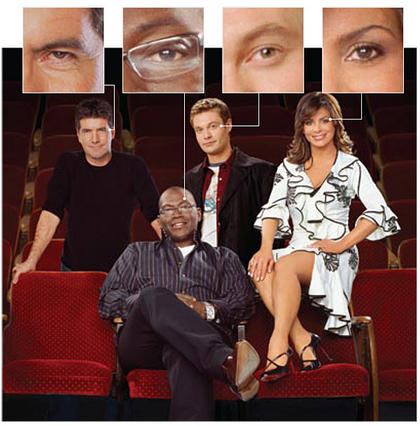
Surrounding lights reflect in eyes to form small white dots called specular highlights. The shape, color and location of these highlights tell us quite a bit about the lighting.
In 2006 a photo editor contacted me about a picture of American Idol stars that was scheduled for publication in his magazine (above). The specular highlights were quite different (insets).
The highlight position indicates where the light source is located (above left). As the direction to the light source (yellow arrow) moves from left to right, so do the specular highlights.
The highlights in the American Idol picture are so inconsistent that visual inspection is enough to infer the photograph has been doctored. Many cases, however, require a mathematical analysis. To determine light position precisely requires taking into account the shape of the eye and the relative orientation between the eye, camera and light. The orientation matters because eyes are not perfect spheres: the clear covering of the iris, or cornea, protrudes, which we model in software as a sphere whose center is offset from the center of the whites of the eye, or sclera (above right).
Link
(Thanks, Barry!)


|
(comment on this)
(comment on this)
(comment on this)
(comment on this)
boingboing_net
|
7:03p
Three wonderful things from the New Yorker
http://feeds.feedburner.com/~r/boingboing/iBag/~3/303319094/three-wonderful-thin.html The New Yorker is always excellent, but the recent issue and its associated online components are especially terrific.

Thing 1: Slide show about Buckminster Fuller
Elizabeth Kolbert writes about the life of Buckminster Fuller and about an exhibition about Fuller at the Whitney Museum of American Art. “By staging the retrospective, the Whitney raises—or, really, one should say, re-raises—the question of Fuller’s relevance,” Kolbert writes. “Was he an important cultural figure because he produced inventions of practical value or because he didn’t?” Here is a portfolio of images from the magazine and the Whitney exhibition.
(Shown here: 4D Tower: Time Interval 1 Meter. Gouache and graphite over positive Photostat on paper.)
Thing 2: Audio file about Auto-Tune
Sasha Frere-Jones writes about Auto-Tune, a pitch-correction software program used in pop music. Here Frere-Jones talks about how Auto-Tune has become a pop-music phenomenon, and demonstrates how it can transform the human voice, with the help of the music producer Tom Beaujour.
Thing 3: Mary Gaitskill reads Vladimir Nabokov’s “Symbols and Signs.”
The New Yorker's Fiction podcast is a treasure. Once a month, a contemporary fiction writer chooses a story from the New Yorker's fiction archives, reads the story, and then talks to the host about why they chose the story and what it means to them.
Mary Gaitskill reads “Symbols and Signs,” Vladimir Nabokov’s first story published in The New Yorker, and discusses it with fiction editor Deborah Treisman.


|
(comment on this)
boingboing_net
|
6:56p
Nanoengineers created blackest-ever black metal
http://feeds.feedburner.com/~r/boingboing/iBag/~3/303316080/nanoengineers-create.html Boston College Physicist Willie J. Padilla and a team from Boston College and Duke Univ. have nanoengineered a material that absorbs all the light that strikes it. How much more black could it be? None more black.
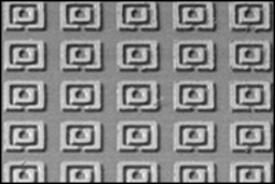 The team designed and engineered a metamaterial that uses tiny geometric surface features to successfully capture the electric and magnetic properties of a microwave to the point of total absorption.
"Three things can happen to light when it hits a material," says Boston College Physicist Willie J. Padilla. "It can be reflected, as in a mirror. It can be transmitted, as with window glass. Or it can be absorbed and turned into heat. This metamaterial has been engineered to ensure that all light is neither reflected nor transmitted, but is turned completely into heat and absorbed. It shows we can design a metamaterial so that at a specific frequency it can absorb all of the photons that fall onto its surface."...
The metamaterial is the first to demonstrate perfect absorption and unlike conventional absorbers it is constructed solely out of metallic elements, giving the material greater flexibility for applications related to the collection and detection of light, such as imaging, says Padilla, an assistant professor of physics.
Link
(via Beyond the Beyond<


|
(comment on this)
boingboing_net
|
6:51p
Google "shell" for your browser
http://feeds.feedburner.com/~r/boingboing/iBag/~3/303311717/google-shell-for-you.html Goosh, a "Google shell" for your browser, is a hell of a lot of fun. Add Goosh to your Firefox searchbar, and you get a bunch of cool shortcuts for powerful searching, and results presented in streamlined, ad-free form:
web (search,s,w) [keywords] google web search
lucky (l) [keywords] go directly to first result
images (image,i) [keywords] google image search
wiki (wikipedia) [keywords] wikipedia search
clear (c) clear the screen
help (man,h,?) [command] displays help text
news (n) [keywords] google news search
blogs (blog,b) [keywords] google blog search
feeds (feed,f) [keywords] google feed search
open (o) <url> open url in new window
go (g) <url> open url
more (m) get more results
in (site) <url> <keywords> search in a specific website
load <extension_url> load an extension
video (videos,v) [keywords] google video search
read (rss,r) <url> read feed of url
place (places,map,p) [address] google maps search
lang <language> change language
addengine add goosh to firefox search box
translate (trans,t) [lang1] [lang2] google translation
Link
(via /.)


|
(comment on this)
(comment on this)
boingboing_net
|
6:31p
Steampunk phonograph
http://feeds.feedburner.com/~r/boingboing/iBag/~3/303305086/steampunk-phonograph.html
This short video demonstrates a working steam-powered photograph on display at a Danish exhibition, though the proud steampunk maker is British. Pato, whose girlfriend shot the video, says, " He stood there playing records all afternoon, tinkering with his machine while spinning tunes. How freaking awesome is that?"
Link
(Thanks, Pato!)
PS: Steampunk, steampunk, steampunk, steampunk, steampunk, steampunk, steampunk, steampunk, steampunk. Steampunk!


|
(comment on this)
(comment on this)
(comment on this)
(comment on this)
boingboing_net
|
3:55p
Canada's DMCA: a guide to the likely talking points
http://feeds.feedburner.com/~r/boingboing/iBag/~3/303227262/canadas-dmca-a-guide.html It looks like Canadian Industry Minister Jim Prentice is about ready to roll out the Canadian version of the dread US Digital Millennium Copyright Act, a terrible copyright bill that has been drafted without consultation with the scores of Canadian organization clamoring for input into the law (on the other hand, it's a sure bet the US trade rep had quite a lot to say about the text). Michael Geist has a handy guide to the likely talking points that the Minister will use to spin his sellout to his buddies in the American entertainment industry.
The bill is the result of extensive discussions with the Minister of Canadian Heritage to ensure that the Canadian approach strikes the right balance between protecting creators and ensuring appropriate access [in reality, the bill as drafted last December was only modestly amended to include a few user-oriented provisions such as time shifting. As mandated by the U.S. and willingly followed by Prime Minister Harper and Prentice, the DMCA-like anti-circumvention provisions remain largely unchanged].
The bill includes important provisions for consumer rights such as time shifting [while long overdue, the time shifting provisions are rendered ineffective in the digital environment by the bill's anti-circumvention provisions. In the event that the bill also includes a format shifting provision to allow for music to be transferred to iPods, the same concern arises since copy-controlled CDs cannot be legally shifted].
The bill ensures that Canada lives up to its international copyright commitments having signed the WIPO Internet treaties in 1997 [Canada is currently fully compliant with its commitments since signing a treaty does not mandate ratification. Further, the government will speak about "implementation" rather than "ratification" since this bill will still not allow Canada to fully ratify the treaties and sticking to implementation will enable the government to delay meeting its commitment to debating international treaties before ratification. Finally, there is great flexibility within the WIPO Internet treaties such that the Canadian approach could easily be far more balanced and still allow for eventual ratification].
Link


|
(comment on this)
ayun

|
3:25p
Hey Everybody, Show Us Your Values!
There are a lot of people taking their government bribes economic stimulus payments to Las Vegas, Disney World, and the local gun shop. And more than a few are using it to buy Euros, which they'll spend in Europe, or otherwise giving the finger to whatever half-baked logic gave us the policy in the first place by taking the money overseas, or at least to Canada. And there's a very sweet picture of a tiny dog with a very big cast on its leg whose vet bills were taken care of, along with a bunch of other pets who are either sad because they are sick, or happy, because they have just scored new families. One dog got acupuncture. A small amount of ink, a large amount of pot, and an inspiring amount of generosity and responsible behavior. A lesbian couple paid their sperm bill, a widower did something for his wife that'll break your heart, and there's a little more whimsy in Baltimore and music in Trenton.
Underlying the "Woo, thanks Uncle Sam!" jollity is a whole lot of anxiety, bitterness and anger, including some kind of obnoxious "Where's mine?" sour grapes.* Also baiting the other side of the aisle. A few people are angry they didn't get more money, or angry that they don't have any of it left. Some people (including me) have taken the opportunity to get judgmental.
Most random money I get goes by default into savings, but the whole site is bizarrely inspiring, especially the people who were very earnest about their charge to do their bit for the American economy. But I haven't even spent this money yet...
Also, totally unrelated, skip directly to the Uses Outside of Fiction section of the Wikipedia entry on "Magical Negro."
* If you live in SF, have two kids, two cars, and a rent-controlled apartment, you're probably not going to live or die by an extra thou or two. We're glad you have a new $200 camera, though! You too, Marin. You guys were both gonna donate it to charity, or Obama, or something, right? Or buy some paintings from a homeless guy? You know that even people who are basically on the same page as you think you're lame, don't you? I mean, I hear you on the cost-of-living jive, totally, but, well, quit bitching. Like, does it bug you at all that the people who needed the check for diaper money or spent it on a webcam to keep in touch with their soon-to-be-deployed spouse have a post on the same page as you?
|
(8 comments | comment on this)
leaky_cauldron
|
3:04p
Radcliffe and Griffiths to Present at 2008 Tony Awards
http://www.the-leaky-cauldron.org/index.php?articleID=11010 Playbill.com is reporting today, actors Dan Radcliffe (Harry Potter) and Richard Griffiths (Uncle Vernon) are among those scheduled to be presenters at the upcoming 62nd Annual Tony Awards. This first list of presenters includes Radcliffe and Griffiths along other actors...
|
(comment on this)
(comment on this)
(comment on this)
boingboing_net
|
2:42p
John Hodgman reviews Jack Kirby’s Fourth World Omnibus for NY Times
http://feeds.feedburner.com/~r/boingboing/iBag/~3/303187673/john-hodgman-reviews.html 
In the NY Times, John Hodgman reviewed Jack Kirby's groundbreaking Fourth World comic book series from DC in the 1970s.
Kirby’s “Fourth World” — a weird saga of warring gods that for a brief moment hijacked the normally staid line of DC Comics and plunged it into bracing, beautiful oddness, and which is now fully and lovingly collected in the four-volume Jack Kirby’s Fourth World Omnibus (DC Comics, $49.99 each).
Besides the psychedelic jump-start he gave to Jimmy Olsen, Kirby started three new titles — “The Forever People,” “The New Gods” and “Mister Miracle.” All chart the conflict between two families of the New Gods: those on the peace-loving planet of New Genesis, and those living in the warlike world of Apokolips. Apokolips is ruled by the evil Darkseid, who seeks the “anti-life equation” that will erase all free will in the universe but his own. Pitted against him is his son, the monstrous yet noble Orion, raised on New Genesis to love peace but ultimately doomed by his addiction to war.
It was a cosmic “epic for our times,” with one foot in ancient myth and the other in the wildest science fiction. And unusually for a comic book story, it was designed to be told slowly, over many years, and to come to an end.
But it was also a personal epic. Kirby, as you ought to know, was the King. He got the nickname while working at Marvel comics, where, with Joe Simon, he created Captain America. Later, with Stan Lee, he helped fashion a completely new, psychologically rich aesthetic in comics, reviving a flagging industry and unveiling a pantheon of pop-culture deities — the Hulk, the Fantastic Four, the Silver Surfer — that still walk the earth today.
Link (Thanks, Dad!)


|
(comment on this)
(comment on this)
(comment on this)
(comment on this)
|

![[info]](http://p-stat.livejournal.com/img/userinfo.gif) cananian's Friends Page
cananian's Friends Page